Sunday, November 1, 2009


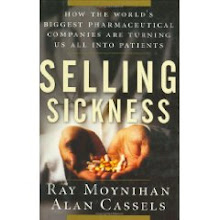
selling SICKNESS
An ill for every pill
Anne Harding
Selling Sickness: How the World's Biggest Pharmaceutical Companies Are Turning Us All Into Patients
2005
Ray Moynihan and Alan Cassels
There's something very wrong here, I thought, my feverish 2-year-old in my lap, as we sat in a paediatrician's dingy waiting room one afternoon. Not a single intact children's book to take my son's mind off his misery, but plenty of colourful displays freshly stocked with glossy brochures touting drugs for attention deficit hyperactivity disorder (ADHD).
You'll see this sort of thing in almost any doctor's office in the USA?Zoloft clocks, Paxil pens, peppy pamphlets advising you to ?take charge of your health? by asking your doc about this or that medication?all of it much newer than the magazines on offer. And as Selling Sickness shows, this is just the tip of the iceberg. Beneath the surface, there's some much more sophisticated salesmanship going on.
Ray Moynihan, a journalist, and Alan Cassels, a policy researcher, describe in ten chapters?each one about a different ?sickness??how the pharmaceutical industry has pushed to widen diagnoses for various conditions, and even in some cases create them, so more people will take the drugs they sell. Given its lax regulations on drug marketing, the USA figures heavily in the book, but the authors' focus is global.
The book opens with a quote from the former head of Merck, who candidly told Forbes Magazine 30 years ago that he dreamed of being able to ?sell to everyone? by making drugs for healthy people. Using a dazzling array of techniques, and plenty of cash, the industry has come a long way toward making this dream a reality.
Enlisting doctors?from free pizza for medical students to thousands in consulting fees to physician ?opinion leaders??is an essential part of the strategy. But the key is to convince as many people as possible that they need a drug. To accomplish this, the industry creates ?patient advocacy groups?, complete with web sites; launches education campaigns for patients; and enlists celebrities willing to ?share their stories?. What these celebs don't share is that they're getting paid. Media outlets often take the bait, doing their part to raise awareness of these so-called diseases.
Moynihan and Cassels interview physicians free of drug industry influence fighting to get the word out to patients that they may not need a pill for every ill?or as one puts it, ?an ill for every pill.? And the authors close by citing what they see as two hopeful examples: the journal PloS Medicine, which takes no drug industry advertising and doesn't run pharma-funded studies, and the American Medical Student Association, which urges members to eschew free lunches from pharma and all that entails. Let's hope that by the time my son is old enough for ADHD drugs these forces prevail.
SOURCE
clinical trial and error
Drug trials in India under investigation after 49 babies die at leading hospital

The deaths occurred over a period of 30 months at the All India Institute of Medical Sciences public hospital in Delhi
SOURCE
Subscribe to:
Posts (Atom)










 Posts